Most businesses should not commission bespoke software for every problem.
That might sound strange coming from a company that develops business systems, but it matters.
There are brilliant off-the-shelf tools for accounting, email, document storage and hundreds of other tasks.
Bespoke development starts making sense when your processes become sufficiently valuable or unusual that generic software is getting in the way.
You've built a business around spreadsheets
Spreadsheets are brilliant.
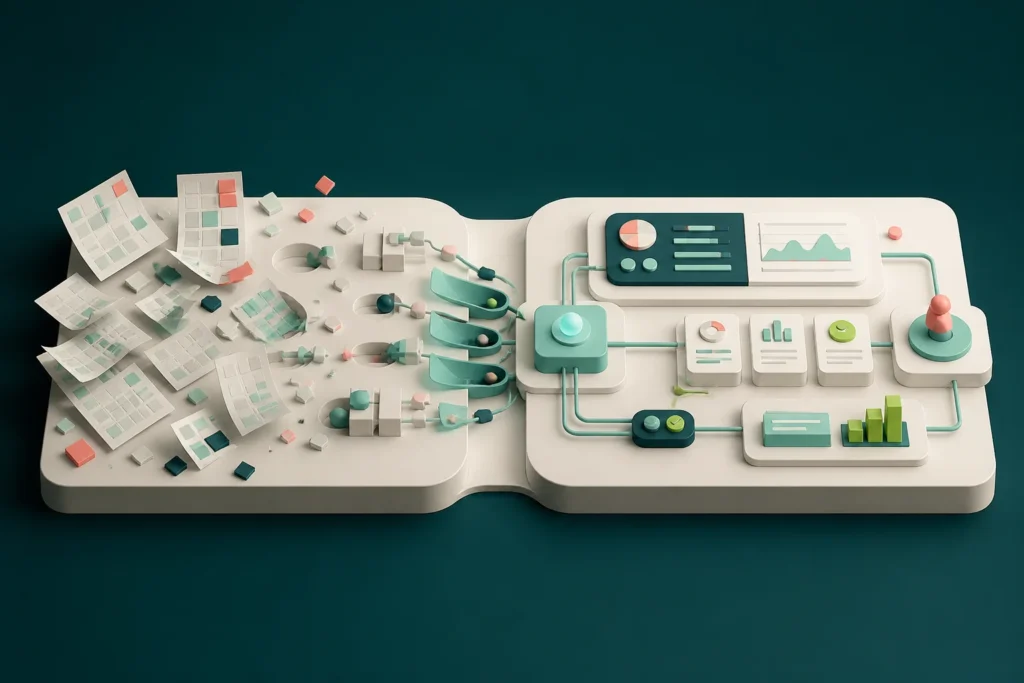
Until the spreadsheet becomes your CRM, job management system, stock system, holiday planner and oracle of all company knowledge simultaneously.
Warning signs include:
- multiple versions
- complicated formulas nobody understands
- manual duplication
- accidental overwrites
- access-control problems
- processes dependent on one employee.
That doesn't automatically mean bespoke software.
It does mean it is worth reviewing the process.
Staff repeatedly enter the same information
If somebody copies information from an email into a spreadsheet, then into another system, then onto an invoice, you have identified an automation opportunity.
The more frequently it happens, the stronger the business case becomes.
Your existing software dictates your process
Software should support how a business operates.
Sometimes businesses end up changing sensible processes purely because their chosen system cannot accommodate them.
EasyMediaUK has previously developed systems around a customer's operating model; its MJS Training project, for example, combined customer management with course, trainer, learner, payment and operational processes and was subsequently adapted as the customer's business changed.
Important information is scattered everywhere
Customer details in one platform.
Job information in spreadsheets.
Tasks in email.
Documents in SharePoint.
Notes in somebody's notebook.
A bespoke platform can create a central operational layer without necessarily replacing every existing specialist application.
Customers need self-service
A customer portal can reduce administration by allowing clients to access relevant information directly.
That could include:
- documents
- project updates
- approvals
- support
- bookings
- account information.
You need systems to communicate
Bespoke development doesn't always mean building an enormous application from scratch.
Sometimes the most valuable work is connecting existing platforms with APIs and automations.
Start with the business problem
Do not begin with:
“We want an app.”
Begin with:
“This process currently takes six hours every week and creates these three problems.”
Then determine the most appropriate technology.
Sometimes the answer will be a configuration change.
Sometimes automation.
Sometimes an existing SaaS platform.
And sometimes bespoke software can fundamentally improve the way the company operates.
That is when it becomes interesting.
Strategy. Creativity. Technology.