An exhibition stand has only a few seconds to earn attention, explain why the business matters and give somebody a reason to step closer. The strongest exhibition experiences are not simply attractive structures. They connect message, environment, people, content and technology around a useful visitor journey.
Begin with the conversation, not the stand
Before discussing walls, counters or screens, decide what the exhibition needs to achieve. Are you launching something, meeting existing customers, entering a new market, recruiting distributors or generating qualified sales opportunities? A stand designed to demonstrate technical equipment should work differently from one built around hospitality or a fast-moving product launch.
Define the people you most want to meet, what they are likely to know already and the next action that would make the event commercially worthwhile. Those decisions give every later creative and production choice a job.
Build a message people can understand while walking
Visitors do not arrive ready to study a wall of copy. From the aisle, the stand should answer three questions quickly:
- Who are you?
- Why might this be relevant to me?
- What should I do next?
A clear headline and one strong visual idea usually work harder than a catalogue of services. Supporting information can then appear where somebody has chosen to engage: on product displays, printed literature, interactive screens, demonstrations or in conversation with the team.
Plan movement, visibility and useful zones
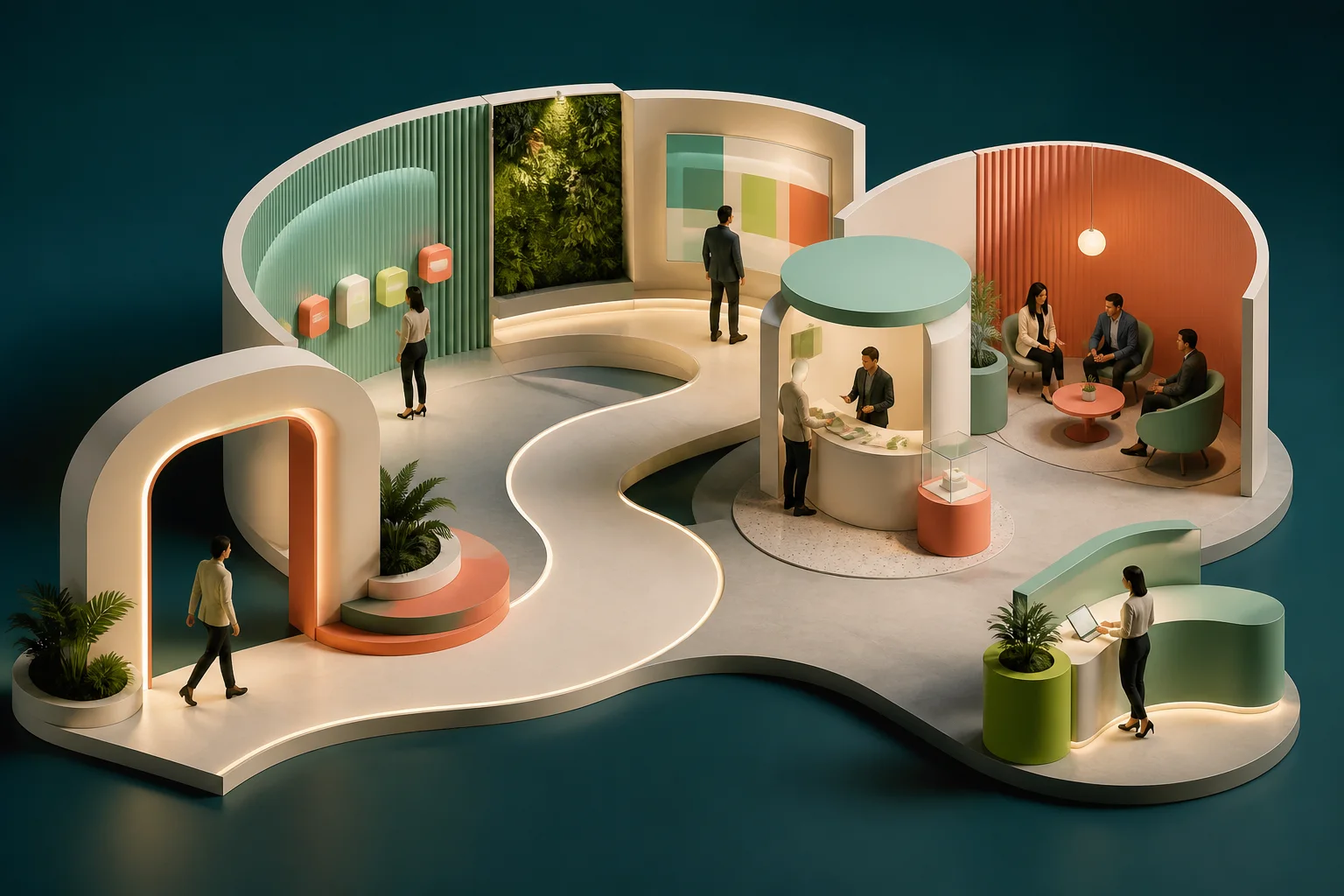
Good spatial design helps visitors understand how to use the stand without being told. An open edge can make the first approach feel easier. A demonstration area needs enough room to gather without blocking circulation. Private conversations may require acoustic and visual separation, while storage, hospitality and staff belongings need to disappear into the design rather than becoming an afterthought.
Consider the stand from every likely direction of travel and at different distances. The elevation that looks strongest in a presentation may not be the first view a visitor sees on the exhibition floor.
Use screens and interaction because they add something
AV can introduce motion, demonstrate a process, show work that cannot physically travel or adapt a message for different audiences. Interactive content can help a visitor explore a complex offer at their own pace. Neither should be included simply because an empty wall is available.
Content should be planned alongside the physical environment. Screen size, viewing distance, ambient noise, lighting and dwell time all affect what will work. A detailed corporate film may be excellent elsewhere but ineffective when played silently above a busy aisle.
Connect activity before, during and after the show
The exhibition itself is one moment in a longer campaign. Before the event, landing pages, email, social content and personal invitations can give the right people a reason to visit. During the show, the team needs a consistent way to capture context—not only scan badges. Afterwards, useful follow-up should reflect the conversation that took place.
Photography, video and short-form content captured at the event can extend the value of the investment, provided their purpose and permissions are considered in advance.
Design for the people working on the stand
A polished environment cannot compensate for a team that is unsure what to say or where to take a visitor next. Give staff a clear briefing covering the priority audiences, key message, demonstrations, qualifying questions, lead-capture process and follow-up responsibility. Practical details—power, connectivity, refreshments, rotas and secure storage—also influence how confidently the team performs.
Measure more than footfall
A busy stand can feel successful while producing few meaningful opportunities. Agree measures that reflect the original objective: relevant conversations, demonstrations completed, meetings booked, opportunities created, existing relationships strengthened or content produced. Record enough information to judge quality as well as quantity.
One joined-up exhibition process
EasyMediaUK brings strategy, identity, stand graphics, animation, film, interactive content, AV and technical production together around one brief. That joined-up approach keeps the physical stand and everything happening around it coherent—from the first invitation to the final follow-up.
Strategy. Creativity. Technology.